

- November 5, 2026
- 10 min read
- Commercial Furniture Guide
- By Craftnika Production Engineering Division
Custom Hotel Room Furniture India vs. Pre-Made: BOQ Guide
For a 50–200 room project, custom hotel room furniture India sourcing typically costs less per key over five years than pre-made collections. Factory-built casegoods use kiln-dried hardwood, mortise-and-tenon joinery and 45D HR foam, avoid trader markups, and ship in 3–4 weeks without rigid minimums.
📋 Table of Contents
- 1. The Core Problem: Why Pre-Made Collections Fail in Hotel Rooms
- 2. 5-Year Replacement Cost: Retail vs. Contract-Grade
- 3. Structural Engineering and Material Standards
- 4. Procurement Framework and CAD-to-Production Customization
- 5. Vendor Comparison: Factory-Direct vs. Traders
- 6. Frequently Asked Questions
Choosing between custom hotel room furniture India factories build to order and pre-made collections is a decision locked in at the BOQ stage and paid for across the next refurbishment cycle. For a 50 to 200 room property, the gap between a headboard that loosens in year three and one that outlasts the refurbishment plan is not cosmetic. It shows up as out-of-order rooms, repeat purchase orders and guest complaints about wobbling nightstands.
This guide is written from the shop floor. It compares both routes on structure, timber, foam, finish and procurement mechanics, so architects and procurement heads can specify against measurable benchmarks instead of showroom samples. If you are shortlisting commercial hotel furniture manufacturers in India, use the checks below to separate genuine contract production from rebadged retail stock.
1. The Core Problem: Why Pre-Made Collections Fail in Hotel Rooms
Pre-made collections are engineered for residential duty. A hotel bed is climbed on, dragged and sat on every day of the year, luggage strikes headboards and desk edges, and air-conditioned rooms put timber through constant humidity change. Retail construction fails in three predictable places:
- Joints. Cam-lock and dowel assemblies loosen under repeated racking, so beds creak and drawers drift out of square within two to three years.
- Foam. Single-density foam in seats and headboard cushions loses support long before the fabric wears out.
- Finish. Thin single-pass lacquer chips at table edges and luggage-contact points, and cannot be matched later to a lot finished months earlier.
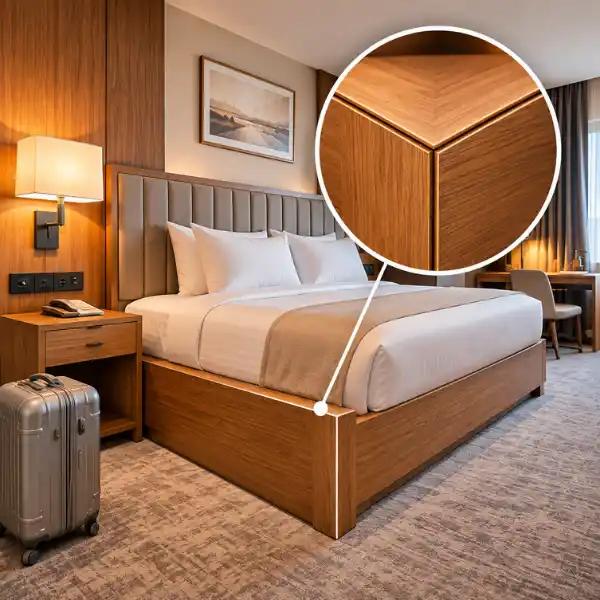
Timber is the first variable to control. The IS 1141:1993 seasoning code from the Bureau of Indian Standards notes that drying to roughly 15–25 percent moisture is considered enough for rough work and outdoor use, with recommended moisture limits for other end uses set in separate standards. A guestroom held at air-conditioned humidity needs wood seasoned well below that band, which is why we kiln-dry hardwood to under 10 percent before it reaches the cutting line.
The financial damage is rarely the furniture price itself. It is rooms pulled from inventory for repairs, a reorder from a collection that no longer matches the floor, and warranties that often exclude commercial use.
Is custom hotel room furniture more cost-effective than buying pre-made collections for a 200-room project?
At 200 rooms, one CAD drawing set and one set of jigs are spread across every key, and every unit comes from the same timber lot and finish batch. Pre-made quotations look lighter because they exclude what the hotel absorbs later. The next section turns that into a formula you can run on your own numbers.
2. How Procurement Managers Calculate the 5-Year Replacement Cost: Retail vs. Contract-Grade Furniture
Purchase price is one line in a five-year model. Procurement heads who benchmark properly build cost per key from five components and run both routes through the same sheet.
- Landed purchase cost. Ex-factory price plus freight, transit insurance and unloading, taken line by line from the architectural BOQ (Bill of Quantities) estimate instead of a lump sum.
- Repairs. Labour hours per loosened joint plus finish touch-up, which retail stock rarely matches to batch.
- Replacement. The share of units you expect to replace within five years. Ask each vendor for actual commercial claim rates, not brochure promises.
- Room downtime. Failed units × repair days × average daily rate.
Consider an illustrative 200-key hotel. If 10 percent of pre-made bed bases and desk chairs need repair or replacement by year three, that is 20 rooms losing several nights each, plus a reorder from a collection that may have changed finish. If contract-grade units hold that figure near zero, the higher unit price is usually recovered within the first refurbishment cycle. Test this with your own failure and ADR data; it is a scenario, not a quotation.
A partner offering turnkey contract furniture manufacturing in India can price each room type from drawings, which keeps the model anchored to quantities instead of assumptions. Direct factory wholesale pricing also removes the trader layer, the largest controllable line in the sheet.
3. Structural Engineering and Material Standards for a Custom Wood Furniture Manufacturer at High Volume
Volume production only protects a hotel if the thousandth unit matches the prototype. These are the controls we run on the floor, and any custom wood furniture manufacturer working at high volume should be able to demonstrate each one.
Timber seasoning and moisture control
We kiln-dry Grade-A teak and seasoned treated hardwoods to below 10 percent moisture, inside the 10–12 percent equilibrium band typical of air-conditioned rooms, then rest boards in a conditioning bay before machining. A pin meter reads every batch at receipt and again before assembly, and boards above limit return to the kiln. Skipping that second reading is how a headboard that fits in the workshop cups after a few weeks in a cooled room.
Frame joinery and durability
Beds are where joinery decides lifespan. For contract-grade upholstered platform beds we use glued, clamped mortise-and-tenon joints with corner gusset blocks, so racking load passes into the frame instead of a single fastener. Hardware is 304 or 316 stainless steel, which resists corrosion in humid properties and survives repeated housekeeping strip-downs. Cam-locks and dowels suit flat-pack retail; in a bed that is moved, cleaned under and climbed on daily, they are the first thing to loosen.
Guestroom suite specifications
A suite is specified as one system. Bed, nightstands, desk, luggage rack, wardrobe and headboard panel share a timber lot, a stain formula and a multi-coat polyurethane schedule with a measured hardener ratio, sanded between coats and fully cured before packing. Our bespoke hotel bedroom furniture suites are drawn in CAD to the room’s clear dimensions, so nightstand heights match the mattress and wardrobe doors clear the bed.
Foam, fabric and seating ergonomics
Seat comfort in a hotel is a durability question. We build seat cores from multi-density 45D High-Resilience (HR) foam with a softer comfort layer on top, which holds its shape far longer than single-density foam. Fabrics are specified at 50,000 to 100,000 Martindale double rubs; light domestic fabrics rated far lower tend to shine and pill at armrests within a season. Fire-retardant options to BS 5852 and CAL 117 are available where brand or local norms require them. For commercial high-traffic lounge chairs, seat height, depth and back angle are drawn for a guest who stays seated for an hour, not for a showroom photograph.
Use this checklist when reviewing any vendor’s technical submission:
- Timber: kiln-dried seasoned hardwood below 10% moisture, with a batch moisture log you can audit.
- Joinery and hardware: mortise-and-tenon with corner gusset blocks and 304/316 stainless steel fasteners on every load-bearing joint.
- Foam and fabric: multi-density 45D HR foam, 50,000+ Martindale double-rub fabric, BS 5852 or CAL 117 options.
- Proof before volume: an approved 1:1 guestroom mock-up room, then 3–4 week dispatch after drawing and finish sign-off.
4. Procurement Framework: Turnkey Hotel Room Furniture Packages and CAD-to-Production Customization
Turnkey FF&E (Furniture, Fixtures & Equipment) procurement puts casegoods, loose seating, upholstery and installation under one scope, which cuts coordination points and finger-pointing. Turnkey hotel room furniture packages work best when the sequence is disciplined:
- Room schedule. Room types, quantities, clear dimensions and brand standards.
- CAD drawings. Per-piece drawings with joinery, hardware and finish callouts, signed off by the architect.
- Material approvals. Timber species, finish panels on the actual wood, fabric swatches and foam density sheets.
- 1:1 guestroom mock-up room fabrication. One fully furnished room built to drawings and inspected by owner, architect and operator before volume production. Most downstream disputes disappear here, because dimensions, comfort and finish are judged on a real unit.
- Batch production and dispatch. Standard dispatch is 3–4 weeks from approval, with floor-wise batches so installation starts early.
Large rollouts run as factory-direct bulk furniture orders with no rigid MOQ, so a ten-suite boutique wing and a 150-room rollout follow the same drawings and standards.
Which hotel furniture manufacturers offer integrated CAD design and factory-direct production?
Look for a drawing office inside the factory instead of a trading desk. When one team issues the CAD, runs the machines and signs the inspection, a change to a nightstand width is a drawing revision, not a three-party negotiation. Before issuing a purchase order, ask to see a drawing set, the mock-up process and a batch moisture log.
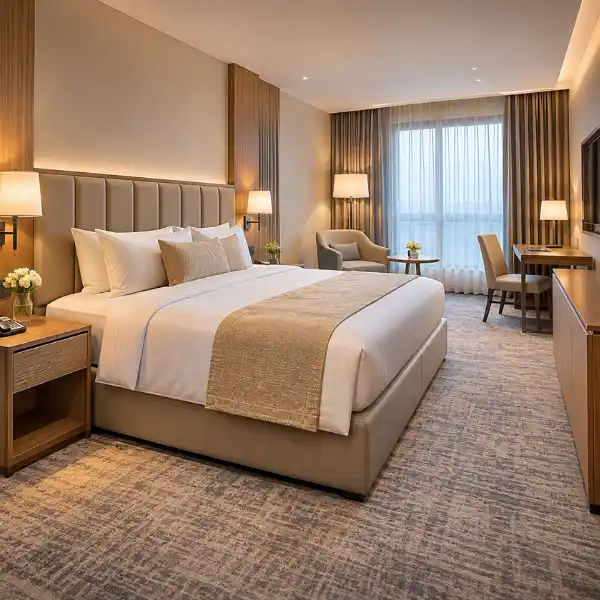
5. Vendor Comparison: Hotel Furniture Wholesale India Channels vs. Factory-Direct Manufacturing
Compare Craftnika’s direct factory model with local traders, importers and retail showrooms on four criteria:
- Structural accountability. At a factory, one party owns drawings, joinery and finish, so a failed joint has one address. With traders and showrooms the maker sits several steps away, and claims pass through a seller who did not build the piece.
- Material transparency. A factory can document timber species, moisture readings, foam density and fabric rub counts per batch. Trader catalogues describe materials that are rarely verified per lot.
- Customization flexibility. Dimensions, finishes and hardware change in CAD within the production run. Showrooms are limited to existing SKUs and finish cards.
- Lifetime cost per key. Direct factory wholesale pricing carries zero intermediary trading markups and keeps batches consistent. Trader quotes start lower and rise through replacements and mismatched reorders.
Pre-made still makes sense in narrow cases: a small top-up of identical items, back-of-house rooms, or an opening date that a 3–4 week dispatch cannot meet. Residential-grade seating in a high-footfall lobby is where budgets are wasted; contract-grade chairs in a staff room are the opposite waste.
Where do luxury hotels and resorts get their custom furniture in India?
From factory-direct manufacturers that run their own design and production. Hotel furniture suppliers for luxury resorts typically start from the architect’s drawings, build a mock-up room, then manufacture in batches.
Resort programmes differ from business hotels in one way that matters. Specialist luxury resort furniture suppliers work to larger room footprints and longer guest stays, which raises the load on seating and desks, while business hotels turn rooms faster and stress bed frames and luggage-contact surfaces.
Request Finish Swatch Boxes or Submit Your BOQ for Estimation
Send your floor plans, room schedule or draft BOQ and our projects team will return a factory-direct estimate. You can also request a physical finish swatch box to review timber, stain and upholstery in your own light. No rigid MOQ, 3–4 week standard dispatch.
Frequently Asked Questions