

- November 12, 2026
- 10 min read
- B2B Buying Guides
- By Craftnika Experts
Commercial Restaurant Furniture Buying Guide: Specs & BOQ
A commercial restaurant furniture buying guide starts with load-bearing specifications: kiln-dried or marine-grade frames, 40D+ foam, fabric above 40,000 Martindale rubs and a zone-wise BOQ. Buying factory-direct removes dealer markups and gives you control over joinery, finish and a 3 to 4 week dispatch.
Most restaurant furniture does not fail on design. It fails at the joints, in the foam and on the finish, usually within the first two or three years and often on the busiest weekend of the quarter. This commercial restaurant furniture buying guide is written from the production side of the table: what we inspect on the factory floor, what belongs in a Bill of Quantities (BOQ), and what separates a chair that survives hundreds of covers a week from one that does not.
It is written for restaurateurs, architects and procurement heads who need to specify restaurant FF&E (furniture, fixtures and equipment) once and get it right, whether the order is thirty chairs for a single café or a multi-outlet rollout. We cover why furniture fails, the material standards that prevent it, a procurement sequence you can copy, and how factory-direct sourcing compares with traders.
1. Why Restaurant Furniture Fails and What Replacement Really Costs
In short: Restaurant furniture fails at four points: joints, foam, finish and fabric. Commercial grade means each is specified with numbers: seasoned frames, 40D or higher foam, finishes tested against cleaning chemicals and fabric rated above 40,000 Martindale rubs. Residential-grade seating usually needs replacing several times within one contract-grade life.
Restaurant seating is loaded in ways residential furniture never sees. Diners tip chairs onto two legs, drag them across tile and drop into booths at speed, while staff wipe every surface with alcohol-based sanitiser several times a shift. Three failure patterns repeat across HORECA projects:
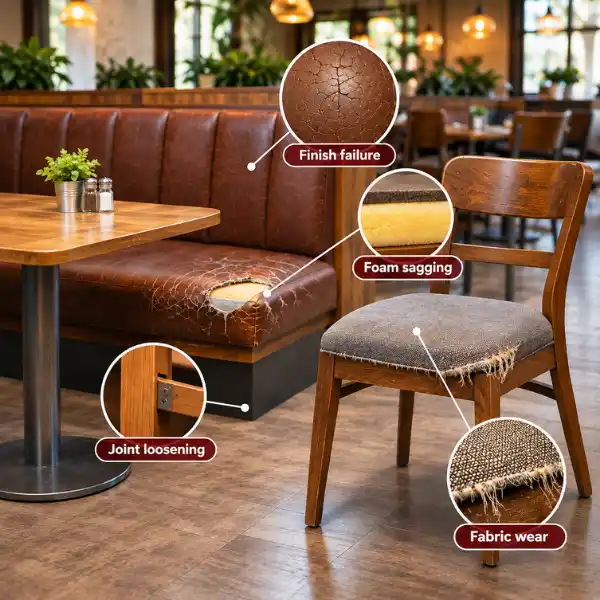
- Joint loosening. Dowel-and-glue or cam-lock joints work loose under racking loads. Once a rear leg starts to rock, the joint is already damaged, and re-gluing rarely holds.
- Foam sagging. Low-density foam compresses permanently within a year of daily use, leaving a visible dip in seats and wrinkled banquette backs.
- Finish failure. Thin single-coat lacquer whitens and lifts under cleaning chemicals and hot plates, which turns a touch-up into a full refinish.
Fabric is a fourth failure point, and the one most often mis-specified. “Heavy-duty” on a quotation means nothing without a test method and a number. The Martindale method, defined in ISO 12947-2, standardises how a specimen’s breakdown is judged, but the standard sets no pass mark of its own. The threshold has to be written into your purchase specification. We treat 30,000 rubs as the absolute floor for a restaurant and specify 50,000 or more for chairs and booths on high-turnover floors.
The financial loss rarely appears on the purchase order. It appears as a replacement cycle. Take an illustrative case: if residential-grade chairs are replaced every two years and contract-grade chairs last six, you buy three chairs for every one, before counting re-freight, covers lost while a section is closed for refit, and the mismatch between old and new batches. That is where restaurant budgets leak: cheap seating in high-footfall rooms. Commercial investment pays back where it carries load, in frames, foam density and finish, not in decorative extras.
2. Structural Engineering and Material Standards
In short: Commercial restaurant furniture is specified zone by zone. Indoor seating is judged on frame joinery, foam density of 40D or higher and fabric rated 50,000+ Martindale rubs. Outdoor seating is judged on corrosion-proof frames, tested coatings and quick-dry cushions. Tables follow a 750 mm height against a 450 mm seat.
Specification is where a buying guide earns its keep. For restaurant furniture tables and chairs of commercial grade, we separate indoor dining, bar seating and alfresco zones, because each fails differently and needs its own material logic. Even luxury restaurant furniture for a fine-dining room hides the same engineering behind a different finish.
Indoor dining chairs: joinery, timber and foam
For premium dining chairs for restaurants, the frame is the investment. We build indoor frames from solid Grade-A teak, kiln-dried and seasoned to an equilibrium moisture content of 8% to 12%. In air-conditioned rooms, timber above that range keeps releasing moisture and moving, which is how hairline joint gaps and creaks begin. Joints are mortise-and-tenon with internal gusset blocks at the seat corners, locked with 304-grade stainless hardware instead of cam-locks or loose dowels. The finish is a multi-coat PU system with a matte, anti-scratch top coat, mixed to the lacquer maker’s hardener ratio and fully cured before upholstery goes on.
Seats take 40D to 45D multi-density, high-resilience PU foam, with nothing below 32D anywhere in the seat or back. The cover is a stain-resistant contract fabric rated at 50,000 or more Martindale rubs, with fire-retardant options to BS 5852 or CAL 117 where an insurer or hotel brand requires them. When you assemble a full commercial dining furniture package, ask every supplier to state four numbers in writing: moisture content, foam density, rub count and finish coat count.
Restaurant tables: tops, bases and ergonomics
A good restaurant table manufacturer can explain why a table wobbles before you see it wobble. Stability comes from the base, not the top: wide-footprint or weighted pedestal bases, four-leg frames braced under the apron, and adjustable levelling glides to absorb uneven floors. Table-to-chair ergonomics matter equally. The standard pairing is a 750 mm table against a 450 mm seat, leaving roughly 300 mm of thigh clearance. A 750 x 750 mm top suits two covers, 750 x 1,200 mm suits four, and round tops ease circulation in tight rooms at the cost of corner space.
Solid timber tops need sealed edges, and marble must be sealed because unsealed stone absorbs wine and citrus. Our range of solid wood and marble dining tables follows these base and clearance rules.
Restaurant bar stools and counter seating
Restaurant bar stools fail first at the footrest, because diners load it with the full weight of their legs. Match heights before anything else: a 900 to 950 mm counter pairs with a 610 to 660 mm seat, and a 1,050 to 1,100 mm bar pairs with a 700 to 760 mm seat, which keeps 250 to 300 mm between seat and counter edge. Footrest rails should be tenoned into the legs, not simply glued on. When you list commercial bar stools in the BOQ, state counter height, footrest position and whether the seat swivels.
Commercial outdoor furniture for restaurants
Terraces, rooftops and alfresco dining face sun, monsoon rain and wet cleaning every day, so the specification changes completely. Frames are marine-grade 6063-T6 aluminium that does not rust, taken through a seven-stage pretreatment and finished with a 60 to 80 micron electrostatic powder coat that is tested against salt spray. Woven elements use UV-stabilised HDPE rope or wicker. Cushions use quick-dry reticulated foam so water drains instead of pooling, and covers are solution-dyed acrylic or olefin with a water-repellent finish. Fasteners are stainless steel, in 316 grade near the coast. The commercial outdoor dining furniture we build follows this specification.
3. Procurement Framework: From Floor Plan to Zone-Wise BOQ
In short: A restaurant furniture procurement plan runs in five steps: count covers per zone, send CAD drawings, approve physical swatches, sign off one pre-production sample, then release the batch. Record every line in a zone-wise BOQ with dimensions, materials and finishes so quotations compare like for like.
Good procurement starts with the floor plan, not the catalogue. Count covers per zone, then work backwards to table sizes, seat types and circulation. Keep service aisles between 900 and 1,000 mm so staff can carry loaded trays without turning sideways. Where a wall allows it, run a banquette: custom dining booths remove the 450 to 600 mm chair pull-back clearance on one side of each table, which often lets you fit an extra table along the same wall.
Match the specification to the format. A fast-turnover café needs lightweight chairs, compact two-tops and wipe-clean surfaces. A fine-dining room can justify upholstered armchairs, heavier tables and finer finishes, which is where luxury restaurant furniture earns its price. A bar or microbrewery should put its budget into counter-height stools and stable high-tops, while an alfresco terrace needs every item weather-rated, including cushions and fixings.
From there the sequence is predictable. Send CAD drawings or dimensioned sketches. Approve physical finish and fabric swatches, because screens misrepresent grain, sheen and colour. Sign off one pre-production sample, then release the batch. Our CAD-to-production customisation carries no rigid MOQ, so a single-outlet café and a multi-outlet rollout follow the same sequence, with standard dispatch in 3 to 4 weeks from approval.
Your restaurant furniture BOQ checklist should carry the following in every line item, so quotations from different suppliers compare like for like:
- Zone and quantity: main floor, booths, bar, terrace and private dining listed separately, with 3% to 5% spares for breakage and future refits.
- Dimensions: seat height, table height, counter or bar height and overall footprint stated per item, in millimetres.
- Indoor frames: timber species, seasoning to 8% to 12% moisture content, mortise-and-tenon joinery and 304 or 316 stainless hardware.
- Foam and fabric: 40D to 45D HR foam, a Martindale rub count with the test method named, and a fire-retardant option where required.
- Outdoor frames: 6063-T6 aluminium, powder-coat thickness in microns and salt-spray test evidence, with UV-stabilised weave and quick-dry foam.
- Approvals and logistics: signed finish swatches, one pre-production sample, packing method, transit insurance and delivery sequence.
- Delivery acceptance: carton-by-carton count against the BOQ, a finish and joint inspection on arrival, and spare fabric and hardware kept for future repairs.
4. Factory-Direct Restaurant Furniture Manufacturer vs Traders
In short: Factory-direct manufacturing gives restaurant buyers traceable quality, transparent materials, full customisation and a lower lifetime cost per cover, because there are no intermediary markups. Traders suit urgent single pieces from ready stock, but rarely offer batch-level accountability on large projects.
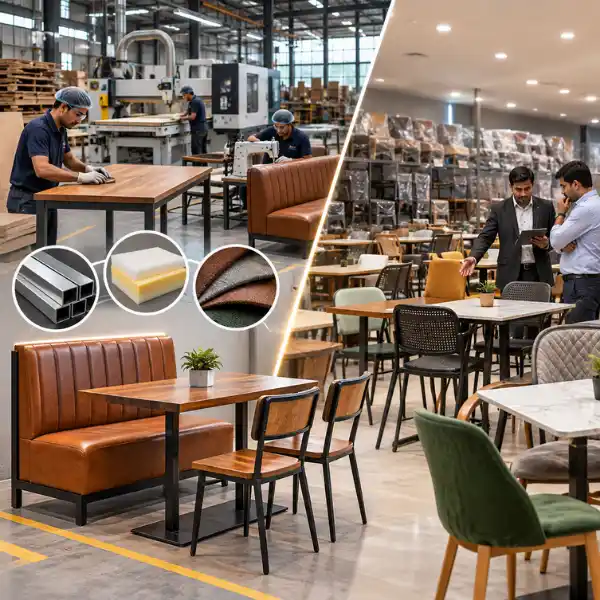
Sooner or later every buyer chooses between a restaurant furniture manufacturer in India that owns its joinery, finishing and upholstery lines and a trader who resells someone else’s output. Both have a place. A showroom suits one decorative piece you need next week. For wholesale restaurant furniture sourcing at project scale, the comparison looks different:
- Structural accountability: A factory that cuts, joins and finishes in-house can trace a failure to a batch and correct it at source. A trader forwards your complaint to a supplier you have never met, and answers take weeks.
- Material transparency: Direct production lets you review frame material records, foam density declarations and fabric test reports before release. Traders often cannot say what is inside the seat.
- Customisation flexibility: A custom restaurant furniture manufacturer works from your CAD drawings, so seat height, back angle, finish and fabric follow the design brief. Trader catalogues offer fixed sizes, and every change means a new quotation from a new source.
- Lifetime cost per cover: Direct factory wholesale pricing removes intermediary markups, and zero rigid MOQs mean you are never forced to over-order. Across a five-year cycle, a lower replacement rate matters more than the unit price on day one.
Before you shortlist any supplier, ask five questions. Who builds the frames and finishes them? Can you see test reports for fabric, foam and coating? Will they sign off a pre-production sample? What is the dispatch window from approval? Who answers for a defect in year three?
Where traders and importers win is ready stock for urgent gap-filling. Where a factory wins is turnkey sourcing of matched tables, chairs, booths and bar seating from one production batch, with a single finish standard across the room. When you compare restaurant furniture manufacturers in India, ask who owns the finishing line and who signs off the sample.
Send Your Floor Plan or BOQ for Factory-Direct Pricing
Share your layout, cover counts and finish preferences, and we will return a zone-wise estimate at direct factory wholesale pricing with no rigid MOQ and 3 to 4 week dispatch. You can submit your restaurant furniture BOQ online, or ask for a physical finish swatch box to review samples before you commit.
Frequently Asked Questions
Standard dispatch is 3 to 4 weeks from approval of CAD drawings and finish swatches. Complex upholstery, new tooling or large multi-zone orders can run longer, and we confirm the schedule in writing before production starts. Add transit and installation days to your opening date, and never plan delivery for the week before launch.
There are no rigid MOQs. A single café ordering twenty chairs and a multi-outlet group ordering several hundred pieces follow the same CAD-to-production process on the same material standards. Mixed quantities of chairs, tables, booths and bar stools can be released as one coordinated batch, so finishes and fabric lots stay consistent.
Ask for the fabric test report naming the method, such as Martindale under ISO 12947, and the cycle count reached. Request a written foam density declaration for each seat type. Then approve one pre-production sample against your BOQ. If a supplier cannot produce these documents, treat the specification as unverified.
Yes. Request a physical finish swatch box covering wood finishes, powder-coat colours and upholstery fabrics. Screens misrepresent grain, gloss and colour, so approve swatches under your restaurant lighting. For a custom colour, send a reference code or sample and we will propose the closest match for approval before the batch is released.