
- October 15, 2026
- 11 min read
- Outdoor Furniture Tips
- By Craftnika Experts
Commercial Outdoor Furniture Specifications Guide: Architect & Tender Checklist (2026)
- A commercial outdoor furniture specification only works when it names the material, the test method, the exposure hours and the pass criterion.
- Frame: 6063-T5 aluminium, 2.0 to 3.0 mm wall, 3-stage pretreatment, 70 to 80 micron polyester powder coat, Grade 316 stainless steel fasteners.
- Weave and soft goods: virgin HDPE tested to 3,000+ hours QUV (ISO 4892-3), reticulated quick-dry foam, solution-dyed acrylic at 30,000+ Martindale cycles.
- Supply: factory-direct from Delhi, no MOQ, 3 to 4 weeks standard dispatch.
Most hotel decks do not lose their furniture to guests. They lose it to one line in the BOQ: “weatherproof outdoor chairs, aluminium frame, UV-resistant wicker.” That sentence names no alloy, no wall thickness, no test method and no pass criterion, so the lowest bidder fills it with whatever looks right in a photograph. This commercial outdoor furniture specifications guide is written for the architect or procurement head who wants to close that gap before the tender goes out.
The cost of leaving it open is predictable. Retail-grade seating shows rust at the joints and chalking on the weave within 6 to 12 months on a hotel deck, and the replacement budget lands on a property that has already paid once. India makes it harder than most markets: a Rajasthan terrace takes 45°C summers with relentless UV, a Kerala resort gets a monsoon deluge that keeps cushions wet for days, and anything near the coast sits in chloride-laden air.
Even the test everyone quotes is widely misread. The ASTM B117 salt spray practice does not set an exposure period for any product, and its own notes warn that results used on their own rarely predict how a part will behave outdoors. So “ASTM B117 compliant” tells you nothing until the BOQ also states the hours and the failure criteria.
What follows is the specification language we would want to see if we were the architect: material grades, thicknesses, test standards, and the failure each one prevents. It is also a fair yardstick to hold against any of the commercial outdoor furniture manufacturers on your tender list, ours included.
Commercial Outdoor Furniture Architectural Specifications: Frames and Fasteners for Extreme Climates
Aluminium frames: why 6063-T5 and wall thickness decide everything
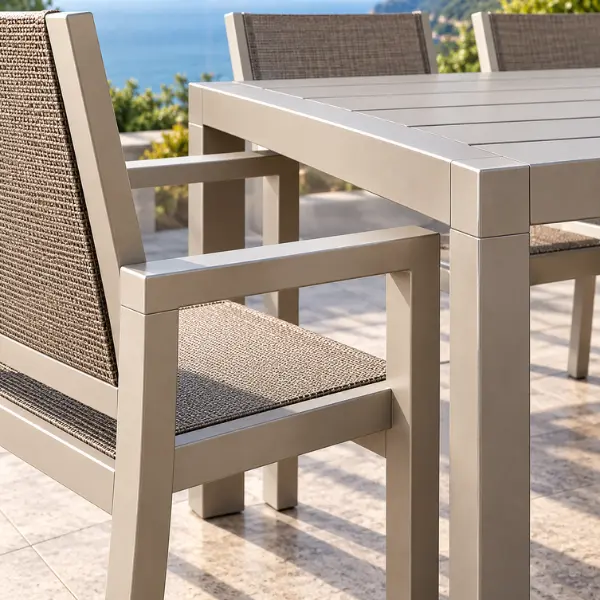
Name the alloy, not just the metal. 6063-T5 structural aluminium is an extrusion alloy with good corrosion behaviour and a surface that takes powder coat cleanly, which is why architects already know it from façade framing. Then fix the thickness, because that is where cost gets cut: a minimum 2.0 mm wall on seat and arm frames, rising to 3.0 mm on sofa rails, table legs and anything carrying sideways load. Thin-wall tube from retail sets tends to flex at the corner joints and fatigue long before the coating gives up.
The question consultants ask us most is the difference between 6063-T5 aluminium and mild steel for commercial outdoor furniture. It comes down to what happens after the finish gets scratched. Aluminium forms a stable oxide film and carries on; mild steel rusts underneath the coat and bleeds orange across the tile. On a poolside, one trolley knock on a mild steel frame becomes a replacement order by the next monsoon. Our outdoor furniture materials comparison goes deeper on each option, and the marine-grade aluminium frames we build follow exactly this specification.
Pretreatment, powder coat and fasteners: where “rust-proof” furniture really fails
A powder coat is only as good as the surface under it. Specify a 3-stage chemical pretreatment (degreasing, etching, conversion coating) followed by an electrostatic polyester powder coat at 70 to 80 micron, cured, with film thickness measured on the finished frame rather than on a test panel. Put the salt spray hours in the BOQ itself, and define failure as blistering or creep from a scribe, not as “no visible rust.”
Then look at the hardware, because that is where aluminium furniture usually fails first. Mandate Grade 316 stainless steel bolts, washers and fixings throughout. Its molybdenum content resists chlorides, so it will not leave rust streaks on pale stone around a pool, which zinc-plated or mild steel fasteners will do within a season on an otherwise flawless frame. Finish the specification with Nylon TPU heavy-duty floor glides so chairs drag cleanly across stone and tile without scratching it.
Two drawing notes also save arguments at handover. Ask for weep holes at the low points of hollow sections so trapped rain and condensation can leave, and require every weld seam to be ground smooth and fully coated before powder application, since a sharp weld edge is exactly where coating thins and corrosion starts. Then make approval of a pre-production sample a condition of the order, so the thickness, finish and hardware you specified are checked against a physical piece before the full batch is built.
Premium Custom Outdoor Furniture Manufacturer in India: every frame we ship from our Delhi factory is built to the specification above, factory-direct, with no MOQ.
Weatherproof Outdoor Furniture Technical Specifications: Weave, Cushions and Tabletops
Weaving and rope: set the UV-stabilisation threshold
Cheap PVC and recycled-blend wicker lasts about one season in Indian sun: the plasticiser migrates out, the surface chalks, and the strands crack at the crossover points. Specify virgin High-Density Polyethylene (HDPE) with UV stabilisers compounded into the polymer, and ask for the proof: 3,000+ hours of QUV accelerated weathering to ISO 4892-3, with a pass defined as no brittle cracking and colour change no worse than grey-scale 4. “UV-resistant” is a sales word; a lab report with hours on it is a specification. Our UV-resistant HDPE wicker is built to this threshold, and the same logic applies to marine-grade rope: stabiliser inside the fibre, not a coating on top of it.
For coastal luxury resorts, add salt-fog and humidity cycling to the weave test and check strand thickness at the crossover points, since that is where thin wicker abrades first.
Cushions and soft furnishings: the monsoon-proof drainage formula
Standard polyurethane foam behaves like a sponge. After one monsoon downpour it holds water for days and goes mouldy from the inside, which guests smell long before they see it. Ban it in writing and specify reticulated open-cell quick-dry foam (QDF), whose cell membranes are removed so water drains straight through, backed by a mesh bottom lining so the core never sits in standing water on a slatted seat. For monsoon outdoor seating the benchmark is simple: the cushion should be usable within hours of the rain stopping, not days. It is the build behind our weatherproof outdoor sofas, and the frame beneath it should follow the 2.0 to 3.0 mm rule above, because a saturated cushion loads the rails.
For the cover, specify 100% solution-dyed acrylic, where the pigment runs through the fibre and cannot bleach out at the surface. Set the floor at 30,000 Martindale rub cycles (35,000+ for lounge seating in high-turnover areas) and 1,500+ hours of lightfastness. Specify the performance, not a brand: any contract-grade fabric that meets those numbers qualifies, which also keeps your tender open to competitive bids.
Tabletops: sintered stone vs. HPL for high-turnover patios
A restaurant patio table takes hot plates, curry, citrus, cleaning chemicals and several turns a service. Sintered stone suits that abuse: it is non-porous (water absorption below 0.5%), highly stain resistant, and tolerates a 120°C hot vessel without marking. Its weak point is the edge under impact, so specify a chamfered or bullnose edge and a rigid supporting frame. Exterior-grade High-Pressure Compact Laminate (HPL) to EN 438-6 is lighter and more forgiving on edges, and with a UV-stable surface layer it holds colour, but check its data sheet against your hot-vessel and stain requirements rather than assuming.
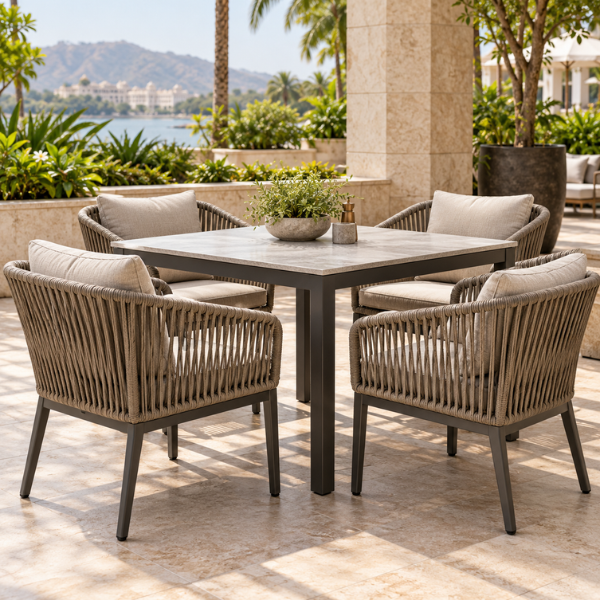
Whichever you choose, write the acceptance tests into the BOQ: a hot-vessel test at 120°C, a stain test with defined reagents (oil, tea, turmeric) and contact time, and a hygiene standard that lets staff wipe down without special cleaners. Our commercial outdoor dining sets pair either top with a 2.0 to 3.0 mm aluminium base and Nylon TPU glides, so tables slide without gouging the deck.
The four lines to copy into every BOQ:
- 6063-T5 aluminium, 2.0 to 3.0 mm wall, 70 to 80 micron polyester powder coat
- Grade 316 stainless steel fasteners and Nylon TPU heavy-duty floor glides
- Virgin HDPE weave, 3,000+ hours QUV accelerated weathering (ISO 4892-3)
- Reticulated quick-dry foam with solution-dyed acrylic, 30,000+ Martindale cycles
Hotel Outdoor Furniture Tender Specifications India: The 5-Point RFP Checklist
A BOQ line that survives tender scrutiny names a material, a standard, the failure it prevents and the climate test that proves it. This is the five-point version we recommend hospitality teams paste into an RFP.
- Aluminium frame. 6063-T5, 2.0 to 3.0 mm wall. Failure risk: bent rails and loose joints inside a year. Indian climate test: sustained load on seat and arm joints after a heat soak at 45°C.
- Coating and hardware. 70 to 80 micron polyester powder coat over a 3-stage pretreatment, Grade 316 fasteners. Failure risk: blistering, creep and rust streaks. Indian climate test: ASTM B117 salt spray with the hours stated in the BOQ, set higher for coastal sites.
- Weave and rope. Virgin HDPE or marine-grade rope. Failure risk: chalking and brittle cracking within one season. Indian climate test: 3,000+ hours QUV to ISO 4892-3.
- Cushion and fabric. Reticulated quick-dry foam with mesh lining, solution-dyed acrylic. Failure risk: mould and fading after the first monsoon. Indian climate test: a soak-and-drain time check, 1,500+ hours lightfastness and 30,000+ Martindale cycles.
- Tabletop and glides. Sintered stone or exterior-grade HPL, Nylon TPU glides. Failure risk: stains, heat marks and scratched decks. Indian climate test: a 120°C hot-vessel test and reagent stain tests.
When bids come back, compare them against these five points before you compare price. A noticeably cheaper quote is almost always cheaper in one of five places: thinner wall, softer hardware, a cheaper weave compound, standard foam, or a test report that was never offered. Putting the five lines side by side makes the difference visible on one page.
Ask every bidder for the matching test reports, not a brochure line. Our quality control process includes UV-stabilisation and salt spray testing on outdoor pieces, and our guide to buying B2B hotel furniture in India covers the wider procurement steps, from shortlisting to site delivery.
Hospitality FF&E outdoor furniture standards: coastal and pool-deck durability
Coastal and poolside decks are the toughest tier in any hospitality FF&E schedule, because chloride from sea air and from chlorinated or salt-water pools attacks metal, fibre and fabric together. Raise the salt spray hours for these sites, keep Grade 316 hardware non-negotiable, and treat mild steel anywhere in the assembly as a defect. Our luxury resort furniture range is specified this way, and the same build sits behind our commercial poolside furniture for deck and cabana use.
Craftnika versus local vendors
- Local vendors usually quote from a photograph and a price per piece; we quote against a written specification, line by line.
- Local hardware is often mild or zinc-plated steel; ours is Grade 316 stainless steel throughout.
- Intermediaries add a margin between you and the factory; we are the factory, so pricing is factory-direct with zero trading markup.
- Local lead times tend to float; ours is 3 to 4 weeks standard dispatch, confirmed in writing.
Three objections, answered
Price. Factory-direct pricing removes the trading margin, and a frame that holds for years costs less per year of service than a retail set replaced after one monsoon.
Lead time. Standard dispatch is 3 to 4 weeks. A complete specification at tender stage protects that window, because a vague BOQ is the usual cause of re-quotes and rework.
Customisation. There is no MOQ, and dimensions, colours, weave patterns and configurations can follow your drawings. Custom does not mean untested: the same specification and test regime apply to every order.
Send Us Your BOQ for a Factory-Direct Quote
Share your drawings or draft BOQ with our Delhi factory and we will respond with a written, line-by-line quote against your specification. No MOQ, 3 to 4 weeks standard dispatch and factory-direct pricing for hotels, resorts and restaurant groups.
More Specification Guides from Our Factory
Recent Posts
Recent Posts
Frequently Asked Questions
Name the material, the test standard, the exposure hours and the pass criterion for every component. For a typical deck that means 6063-T5 aluminium at 2.0 to 3.0 mm wall, a 70 to 80 micron polyester powder coat, Grade 316 stainless steel fasteners, virgin HDPE tested to 3,000+ hours QUV (ISO 4892-3), reticulated quick-dry foam and solution-dyed acrylic. Make the matching test reports a tender requirement.
6063-T5 aluminium forms a protective oxide film and does not rust, so a scratched coating stays a cosmetic issue. Mild steel rusts underneath the powder coat, stains tile and stone, and weakens at the joints. For hotel decks, pools and coastal sites, aluminium frames with Grade 316 stainless steel fasteners are the safer specification.
Specify reticulated open-cell quick-dry foam, where the cell membranes are removed so water drains through instead of being held, with a mesh bottom lining under the cushion. Pair it with solution-dyed acrylic rated at 30,000+ Martindale cycles. The practical test is simple: the cushion should be usable within hours of the rain stopping, not days.
Require virgin HDPE with UV stabilisers compounded into the polymer, tested to 3,000+ hours of QUV accelerated weathering (ISO 4892-3) with no brittle cracking and limited colour change. For coastal sites, add salt-fog and humidity cycling, Grade 316 hardware, and a check on strand thickness at the crossover points where thin wicker abrades first.
Sintered stone and exterior-grade HPL (EN 438-6) are the two practical choices. Sintered stone is non-porous, highly stain resistant and tolerates a 120°C hot vessel, while HPL is lighter and more forgiving on edges. Whichever you choose, write a hot-vessel test, a stain test and an edge detail into the BOQ.
No. ASTM B117 describes how to run a salt spray test but does not set an exposure period for any product, and its notes caution that salt spray results alone rarely predict outdoor performance. Always state the hours and the failure criteria, such as blistering or creep from a scribe, in the BOQ.