
- October 20, 2026
- 11 min read
- B2B Buying Guides
- By Craftnika Experts
How to Export Wooden Bed Frame from India: Global Procurement and Manufacturer Guide (2026)
- Exporting a wooden bed frame from India succeeds or fails on five controls: species, moisture, joinery, packing and documents.
- Timber: kiln-dried plantation teak at 8% to 10% moisture, with readings taken on finished parts.
- Paperwork: HS Code 940350, a phytosanitary certificate where the destination requires it, ISPM-15 heat-treated pallets and CITES support for any Sheesham.
- Supply: factory-direct from Delhi, no MOQ, 3 to 4 weeks standard dispatch, KD flat-pack for FCL or LCL.
A container of bed frames can clear Indian customs on Monday and sit on a quarantine hold in Rotterdam or Long Beach by the time the hotel’s opening date starts to slip. In most cases the paperwork was not the real problem. The timber was: wet at stuffing, vague about species, or packed on pallets that never carried the right stamp. If you are working out how to export wooden bed frame from India for a hotel project, the job is less about finding a factory and more about controlling five variables before the first cut: species, moisture, joinery, packing and documents.
Most pages ranking for this question are trade-data portals that list HS codes and past shipping bills but never explain what happens inside the factory. Buyers are also told they need an “ISPM-15 certificate” for the bed itself, which is a frequent misreading. The International Plant Protection Convention’s ISPM 15 standard covers wood packaging material such as pallets, crates and dunnage. It is about the box the bed travels in, not the bed.
The cost of getting this wrong is concrete: a rejected or re-treated container, split headboards on arrival, a handover date missed by weeks, and a replacement order that costs more than the original. We manufacture and export solid wood beds from our Delhi factory, so this guide sets out what we actually do, in the order a procurement team needs it.
Wooden Bed Frame Manufacturers in India for Export: Factory-Direct or Trading House?
Trade-data portals put India’s furniture exports at roughly US$1.8 billion in FY 2024-25, with the USA the largest destination and bedroom furniture under HS 940350 a much smaller slice of that total. The category is real, but it is fragmented, and a good share of exporters are traders who hand the actual making to whichever workshop has capacity that month. On a 150-room hotel order, that is exactly where moisture levels and tolerances drift apart between batches.
The test is simple. Ask who owns the kiln, who cuts the joinery and who runs the finishing line. A factory-direct supplier answers with photographs and batch records; a trading house answers with a brochure. Our hotel furniture manufacturers in India operation keeps seasoning, machining, assembly, finishing and packing under one roof, which is why we can offer factory-direct pricing, no MOQ and 3 to 4 weeks standard dispatch from the factory gate.
Buyers who visit our custom hotel bed frame manufacturing plant in Delhi NCR usually ask to see three things before they sign: the moisture log for their batch, a knock-down joint being assembled, and a packed carton. If a supplier is reluctant to show you any of the three, that already tells you what you need to know.
Solid Wood Bed Frame Export from India: Species, Kiln-Drying and the 8% to 10% Rule
How to source kiln dried teak bed frames from Indian factories
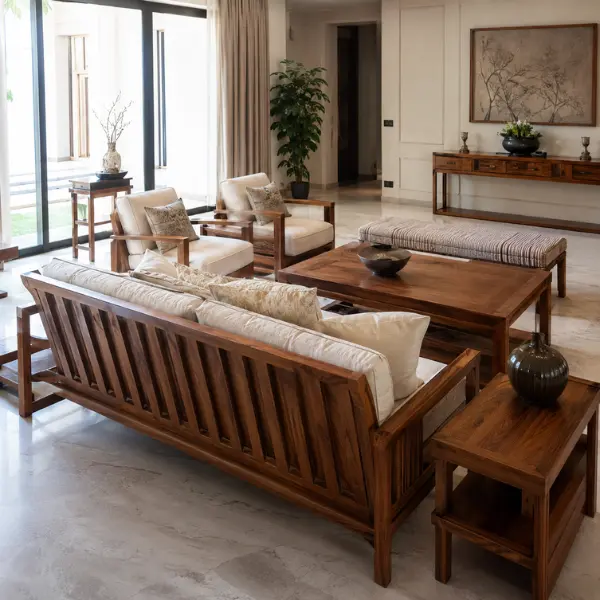
Plantation teak (Tectona grandis) is the benchmark for hotel beds because it stays dimensionally stable, resists insects and tolerates the temperature swing a sealed container goes through. When you plan how to source kiln dried teak bed frames from Indian factories, ask for three things in writing: the species and origin of the timber, the kiln schedule, and the moisture reading taken on the finished component rather than the rough plank. Seasoned Sheesham and treated hardwoods suit some mid-scale briefs, but they come with different paperwork, as the compliance section below explains.
Wood moisture content standards for exporting furniture to USA and Europe
There is no single legal number, which is exactly why disputes happen. The working target for most hospitality buyers is 8% to 10% moisture equilibrium, because heated and air-conditioned interiors in North America, Northern Europe and the Gulf typically settle somewhere between 6% and 10%. Ship timber at 14% into a dry hotel in Dubai or a heated one in Munich and the boards shrink, tenons loosen and headboards split along the glue line within the first season.
Moisture also moves in transit. A container that crosses monsoon-season ports can take water back in unless components are sealed in cartons with desiccant, so we take pin-meter readings on finished parts before packing and keep them with the batch file. Ask any supplier, us included, for that record.
Custom Teak Wood Bed Frames Wholesale Export: Joinery, KD Engineering and Headboards
This is where our luxury beds in India range begins: solid teak rails, slats and headboards cut for mortise and tenon joints, then finished to a hotel-grade lacquer. Headboards can be panelled, slatted or upholstered over a solid frame, and every design is drawn against the room’s actual bed size and mattress depth, not a catalogue default.
Squeak-free bed frame engineering
Squeaks are a joinery problem, not a finishing problem. Tenons are fitted tight and glued where the joint is permanent, and every knock-down connection uses a threaded steel insert or bed bolt seated against hardwood, so the joint grips again after being taken apart and rebuilt on site. Slat bearers are fixed to a continuous ledger rather than loose cleats, because loose cleats are where the noise starts around month eight.
Flat pack knock down wooden bed frame manufacturing for export containers
Knock-down (KD) joinery is what makes export economical. Headboards, rails and slats ship flat, which lifts the number of beds per container and cuts the freight carried per room. The trade-off is site assembly, so we label every component, include a one-page assembly sheet and pack a small allowance of spare bolts and inserts in each carton. Hotel engineering teams will thank you for that last detail.
Hotel Bedroom Furniture Exporter India: Ship the Whole Suite, Not Just the Bed
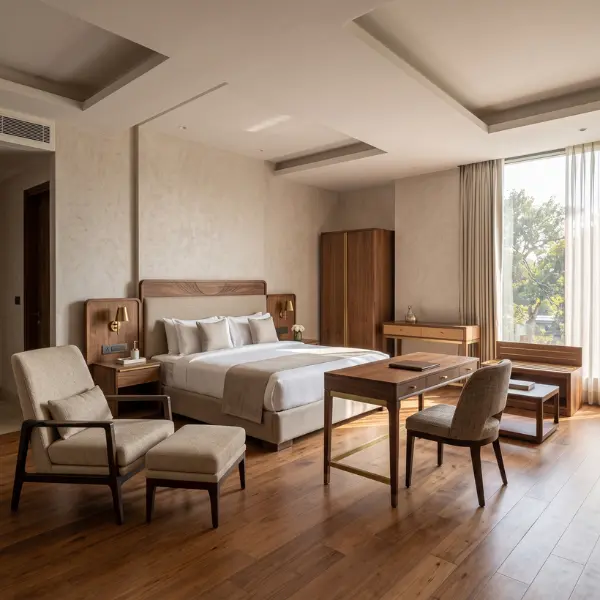
Developers rarely buy a bed in isolation. A typical key needs a bed, two nightstands, a desk, a luggage bench and a wardrobe, and producing them in one run keeps the finish batch consistent from the first room to the last. Our bedroom furniture for hotels packages are built this way, as turnkey hotel FF&E bedroom suites with one approved sample and one finish standard across the whole order.
Matching casegoods matter more than buyers expect. A nightstand in a slightly different teak tone is the first thing a design consultant will flag at snagging. Our luxury side tables are cut from the same seasoned stock as the beds, so grain and colour stay in step.
If you are planning the commercial side of the programme, our guide to the B2B hotel furniture procurement process covers sampling and approvals, and independent properties can see how bespoke work is handled on our boutique hotel furniture page.
Phytosanitary and Fumigation Certificate for Wooden Furniture Export from India
This is the section most competing guides skip, because it needs a clear line between what the furniture needs and what the packaging needs. The bed frame itself is finished, kiln-dried, lacquered timber. The pallet and crate under it are raw wood, and that is what ISPM 15 targets: heat treatment to 56°C at the core for at least 30 minutes, followed by a permanent IPPC mark showing the country code, producer number and treatment code.
A phytosanitary certificate, issued by India’s plant quarantine authority, and any fumigation or treatment declaration on the timber itself are separate documents. A destination asks for them only when its import rules say so, and Australia and New Zealand are the usual examples. Check the destination’s conditions before production, not after. For a typical shipment, the paperwork stack looks like this:
- Import Export Code (IEC) from DGFT, mandatory for every Indian exporter.
- HS Code 940350 (wooden furniture of a kind used in the bedroom), with 94035010 as the Indian 8-digit line for bedsteads. Confirm the classification of slat bases separately with your customs broker.
- Commercial invoice and packing list naming the timber by botanical name, because misdeclared species invite reassessment and penalties.
- Certificate of origin for tariff treatment at destination.
- Phytosanitary certificate whenever the destination requires one.
- ISPM-15 compliant heat treatment on every pallet, crate and dunnage piece, with the IPPC mark visible on two sides.
- Timber legality records supporting a US Lacey Act declaration and the EU and UK timber due-diligence rules.
- Shipping bill, Let Export Order and bill of lading to close the Indian side of the export.
The Sheesham trap
The entire Dalbergia genus sits in CITES Appendix II, and that includes Sheesham (Dalbergia sissoo). Relaxations agreed in 2022 cover small items under 10 kg each, but a bed frame weighs far more, so Sheesham beds generally still need CITES permit paperwork, with the Export Promotion Council for Handicrafts running a timber-legality certification to help exporters comply. Teak does not carry that listing, which is a practical reason we steer international hotel programmes with fixed opening dates towards teak. Rules change, so confirm the current position with your importer before you commit.
Packing and Container Logistics: ISTA-3A, FCL Stuffing and LCL Shipping
Damage in transit is the most expensive failure because it arrives after you have paid. Specify drop-tested 5-ply corrugated export cartons with corner and edge protection on headboards, foam separation between lacquered faces, and carton validation against ISTA-3A packing standards. Ask every bidder for the drop-test report. Cartons then go on ISPM-15 stamped pallets, and we photograph each pack-out at stuffing so a claim, if one ever comes, has evidence behind it.
FCL (Full Container Load) suits hotel orders that fill most of a 20 or 40-foot container, because a sealed, single-consignee load is handled less and cleared faster. LCL shipping works for pilot rooms and mock-up suites, but your cargo shares a box with other shippers, passes through a consolidation warehouse and carries more risk of delay.
Build the sea leg into the programme honestly. Red Sea rerouting has stretched some India to Europe sailings to around 42 days, and that sits on top of production time. Work backwards from the handover date, not forwards from the order date, and leave a buffer for customs inspection at destination.
Craftnika vs Local Vendors: Price, Lead Time and Customization
Premium Custom Wooden Bed Frame Manufacturer in India, built for export from the first drawing.
Three objections come up on almost every enquiry, so here are straight answers. “Is it dearer than a trader?” Usually the quote is level or lower, because there is no trading layer between you and the factory. A noticeably cheaper bid tends to save money in one of four places: thinner stock, wetter timber, loose hardware or lighter packing. Our guide to hotel furniture cost per room in India shows how those line items add up.
“Can you hit my programme date?” Standard dispatch is 3 to 4 weeks after sample approval, with sea freight on top. Where an opening date is fixed, we agree the schedule backwards from handover. “Can you build to my design?” Yes. There is no MOQ, so one prototype bed can be approved before the production run starts, and drawings or mood boards both work as a brief.
Side by side with a typical local vendor, the differences look like this:
- Timber: local vendors often buy whatever stock is cheapest that week; we specify seasoned, kiln-dried teak and treated hardwoods and log moisture per batch.
- Joinery: mortise and tenon with threaded steel inserts and KD hardware, against screwed butt joints that loosen in the first year.
- Packing: drop-tested 5-ply corrugated cartons on stamped pallets, against loose crating and wrap.
- Documentation: species-named invoices, ISPM-15 stamped packaging and phytosanitary or CITES support, against generic paperwork that stalls at the port.
- Accountability: one factory and one point of contact, against a chain of subcontractors.
Send Us Your Bed Frame Spec for a Factory-Direct Export Quote
Share your room count, bed sizes and finish reference and contact our export team. We reply with a written, line-by-line quote that covers documents, packing and a container plan. No MOQ, 3 to 4 weeks standard dispatch and factory-direct pricing for hotel developers, importers and sourcing agents.
More Sourcing and Specification Guides from Our Factory
Recent Posts
Frequently Asked Questions
Shortlist factories that own their kiln and machining rather than trading houses. Ask in writing for the botanical species and origin of the timber, the kiln schedule, and moisture readings on finished components, targeting 8% to 10%. Approve one prototype bed before production, then check batch records against it. A factory-direct supplier such as Craftnika can share these records with the quote, with no MOQ and 3 to 4 weeks standard dispatch.
Not always. ISPM 15 applies to wood packaging such as pallets and crates, which must be heat treated to 56°C at the core for at least 30 minutes and stamped with the IPPC mark. A phytosanitary certificate or fumigation declaration on the furniture itself is needed only when the destination’s import rules require it, as Australia and New Zealand often do. Confirm the destination’s conditions before production begins.
Aim for 8% to 10% moisture equilibrium, measured on finished components. Heated and air-conditioned interiors in North America and Northern Europe typically settle between 6% and 10%, so timber shipped above that range tends to shrink, loosen tenons and split headboards. Keep pin-meter readings with each batch and seal cartons with desiccant for monsoon-season transit.
Yes, when it is engineered properly. Mortise and tenon joints are fitted tightly and knock-down connections use threaded steel inserts or bed bolts seated against hardwood, so the frame stays squeak-free after assembly on site. KD packing also raises container density, which lowers freight per room on both FCL and LCL shipments.
Teak is the safer choice for export. Sheesham (Dalbergia sissoo) falls under the CITES Appendix II listing of the Dalbergia genus, so bed frames generally need permit paperwork, while teak does not carry that listing. Confirm current rules with your importer and keep botanical names on every invoice.