
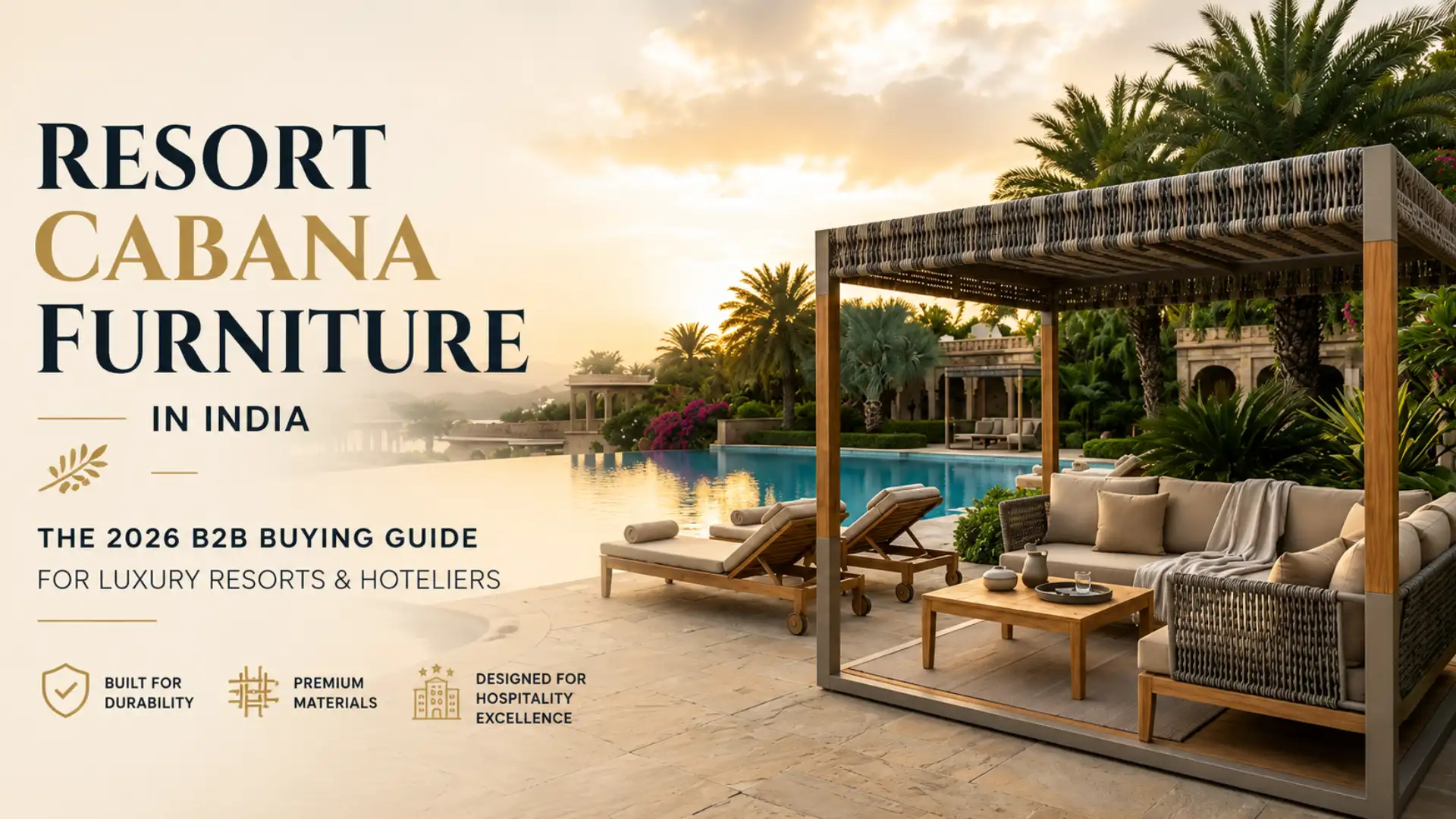
Resort Cabana Furniture in India: The 2026 B2B Buying Guide for Luxury Resorts & Hoteliers
Executive Summary
Most resort cabana furniture sold in India fails within 2–3 monsoon cycles because it's built on mild-steel frames or unsealed teak rather than materials engineered for chlorinated, humid, high-UV poolside conditions. Resorts sourcing TIG-welded aluminum or marine-grade teak cabanas directly from a factory — instead of through a trading intermediary — cut lifecycle costs, avoid delivery delays, and get warranties that actually hold up.
This guide covers:
- Why most cabana furniture fails before year three, and the material science behind it
- What to verify before signing a bulk purchase order
- How TIG-welded aluminum compares to iron, teak, and PE rattan for poolside use
Related Guide: Resort Poolside Furniture Guide: Commercial Umbrellas & Bar Stools
Walk any five-star poolside in India three years after a furniture rollout, and facilities managers tend to report the same three complaints: rust bleeding at weld joints, fabric fading and cracking, and wood that warps or greys despite being sold as \”teak.\” This is the core gap in the market — most suppliers sell furniture designed for residential patios, rebranded for commercial poolside use. Commercial-grade resort cabana furniture has to survive daily chlorine exposure, sunscreen oils, monsoon humidity, and heavy guest turnover, which is a fundamentally different stress profile than a home backyard.
Why Most Resort Cabana Furniture Fails Before Year Three
Three recurring failure points show up across resort procurement audits: mild-steel frames that were MIG-welded and powder-coated instead of TIG-welded in marine-grade aluminum; upholstery labeled \”outdoor\” that isn’t actually solution-dyed, UV-stabilized acrylic; and cabanas marketed as teak that are really mixed hardwood with a teak veneer. Each of these cuts years off usable lifespan in a commercial pool environment.
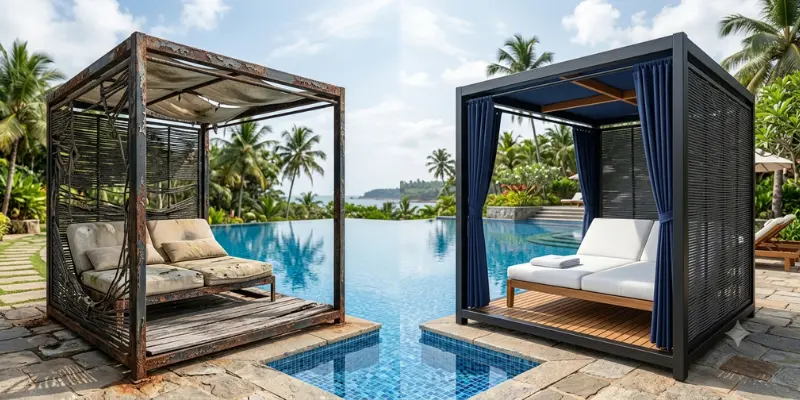
Commercial cabana furniture isn't a decorating choice — it's an engineering decision that determines whether a poolside investment survives its first monsoon season.
What B2B Buyers Should Verify Before Signing a Bulk PO
Before committing to a resort cabana furniture supplier, procurement teams and architects should verify the following:
- Weld type and warranty terms — confirm frames are TIG-welded and ask exactly what the corrosion warranty covers.
- Fabric specification sheets — confirm solution-dyed, UV-resistant outdoor fabric, not just an \”outdoor-labeled\” print.
- Factory vs. trading company — sourcing directly from a Premium Custom Furniture Manufacturer in India typically means tighter pricing control, faster customization turnaround, and direct accountability on defects.
- Sample unit testing — request a physical sample cabana for on-site weather exposure before placing a full bulk order.
- Customization lead times — ask about turnaround for canopy fabric, frame color, and daybed sizing, especially for phased or multi-property rollouts.
📌 Top 4 Things to Check Before You Buy
- Weld Quality: TIG-welded aluminum resists corrosion far better than MIG-welded mild steel.
- Fabric Grade: Solution-dyed, UV-stabilized acrylic outlasts standard outdoor-labeled polyester.
- Wood Authenticity: Grade-A kiln-dried teak, not a teak veneer over mixed hardwood.
- Sourcing Model: Factory-direct pricing and accountability beat multi-layer trading chains.
📌 Material Science Snapshot
- Aluminum oxide layer: Aluminum self-forms a protective oxide layer, unlike iron, which rusts progressively once its coating is breached.
- Weld integrity: TIG welding produces cleaner, less porous joints than MIG welding, reducing points where corrosion can start.
- Teak’s natural oils: Grade-A teak‘s natural oil content gives it inherent water resistance, but only when kiln-dried and properly sealed.
Aluminum vs. Iron vs. Teak: Which Cabana Frame Material Wins?
| Factor | TIG-Welded Aluminum | Mild Steel / Iron |
|---|---|---|
| Corrosion resistance | High — natural oxide layer resists rust | Low — prone to rust bleed at welds |
| Weight | Lightweight, easy to reposition | Heavy, harder to reconfigure |
| Long-term B2B cost | Higher upfront, lower lifecycle cost | Lower upfront, higher replacement cost |
✅ Look For This
- TIG-welded aluminum frames
- Solution-dyed, UV-stable fabric
- Factory-direct pricing transparency
❌ Avoid This
- MIG-welded mild steel with powder coat only
- Fabric merely labeled \"outdoor\"
- Multiple unnamed trading intermediaries
Signs of a Reliable Supplier
- TIG-welded aluminum or Grade-A teak construction
- Transparent factory-direct pricing
- Physical sample units available for testing
Red Flags to Watch For
- No clarity on weld type or fabric grade
- Vague or shifting delivery timelines
- Unwillingness to provide warranty documentation in writing
Aluminum vs. PE Rattan vs. Teak: Choosing the Right Cabana Build
| Build Type | Best For | Maintenance Level |
|---|---|---|
| TIG-welded aluminum + PE rattan | Lightweight, low-maintenance, natural rattan look | Low |
| Solid teak wood | Luxury heritage-style resorts, premium aesthetic | Medium (requires oiling/sealing) |
| Powder-coated aluminum + canopy fabric | High-turnover commercial pools, fast cleaning | Low |
Ready to Source Factory-Direct?
Get factory-direct pricing, custom cabana specifications, and pan-India delivery for your resort's poolside rollout.
Frequently Asked Questions
Written by Craftnika Experts
Our team brings over a decade of experience manufacturing premium commercial furniture for the hospitality industry across India, engineered specifically for poolside and outdoor resort environments.